Match the tool to your bottleneck
Volume or relevance - decide which is stuck before comparing products.
"Prospecting tools" covers a wide range - contact databases, email finders, enrichment platforms, AI SDRs, sequencers, and niche-first discovery tools. They are not interchangeable, and the best one depends entirely on where your prospecting actually gets stuck. This is the overview: the categories, how to choose, and where each fits - including honest placement of our own tool.
Pay only for what you use · $1 = 100 credits · Credits never expire · Zero-result searches refunded
Review the actual search setup and result format before spending credits or starting a campaign.
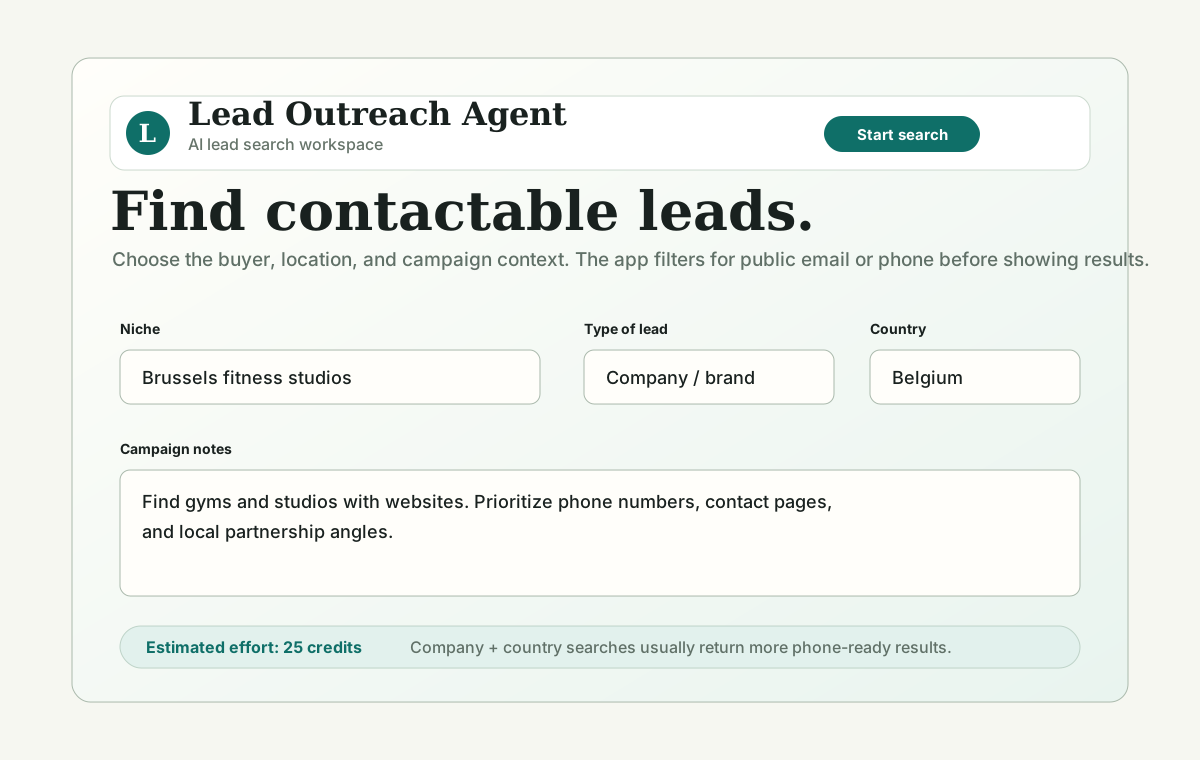
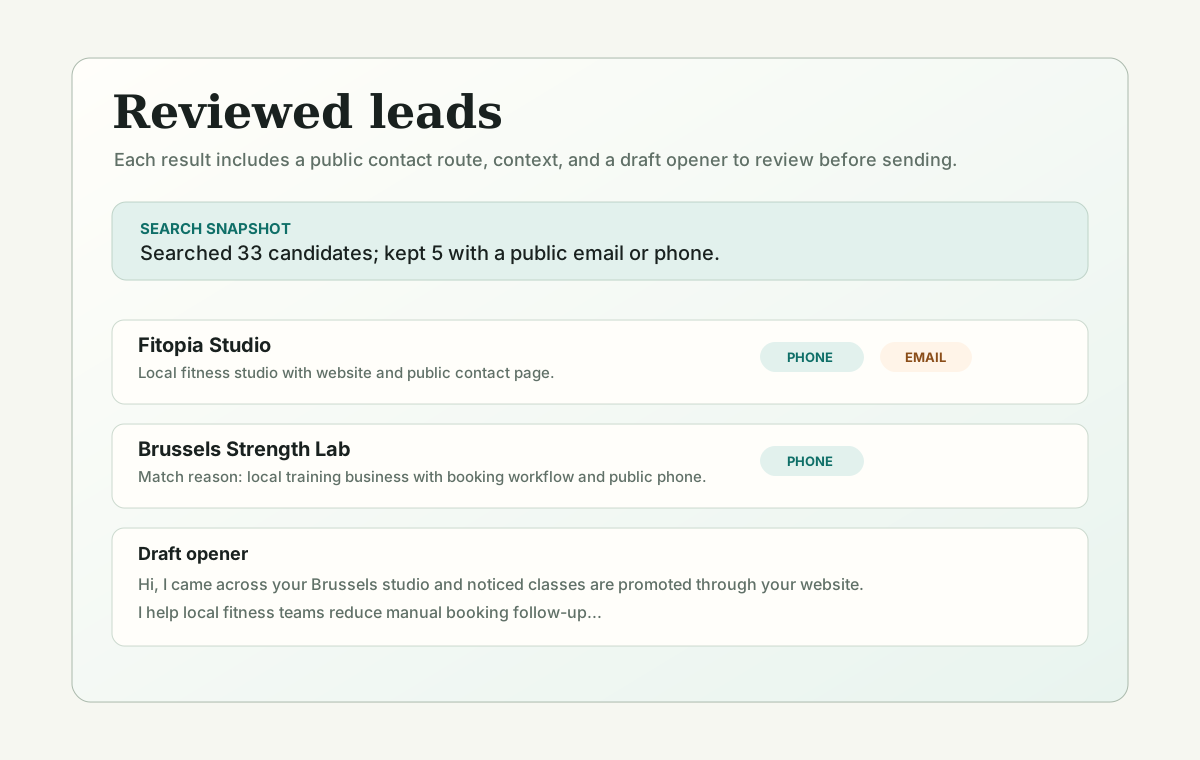
Volume or relevance - decide which is stuck before comparing products.
Nexiloq only shows leads with a real public email or phone, plus the source.
Use the lead-cost calculator to plan a small, honest test.
Use these findings as context, not promised results. Each source includes its sample or method and the limitation that matters when applying it.
Teams that use AI to make each message more relevant report meaningfully higher reply rates - signal-personalized outreach around 15-25% versus a 3-5% cold average - while teams that use AI only to send more messages underperform the human baseline.
Aggregated analyses put B2B contact-data decay at roughly 22.5-30% per year - about 2.1% per month - and as high as 70% at fast-moving tech companies, with job-title changes the single biggest driver.
Sales reps report spending almost one workday per week prospecting; 92% of sales professionals using AI agents say AI benefits prospecting.
B2B buyers use an average of ten channels during the purchasing journey, and market leaders are four times more likely to deploy true one-to-one personalization.
Results need a usable public email or phone number and enough source context for review.
Each result includes context to help you check why the lead fits before outreach.
Drafts remain editable and should be reviewed for accuracy, relevance, and compliance before sending.
The landscape by category, with what each is best at and the catch. Pick the category that fixes your bottleneck, then compare products inside it.
| Category | Best at | Watch out for | Examples |
|---|---|---|---|
| Contact databases | Filterable volume at scale | Static records that decay 22.5-30%/yr | Apollo, ZoomInfo, Cognism |
| Email finders | Turning a known domain into an address | Guessed emails that still bounce | Hunter, Snov.io |
| Enrichment / automation | Custom data workflows | Setup-heavy; you build the pipeline | Clay |
| AI SDRs | Autonomous research and send | Deliverability and compliance risk | 11x |
| Sequencers | Sending and tracking at scale | Not discovery; needs a lead source | Outreach, Instantly |
| Local / Maps | Nearby businesses with a phone | Duplicates and dead listings | Google Maps finders |
| Niche-first discovery | Reviewed, contactable leads + a first draft | Not a database - built for targeted campaigns | Lead Outreach Agent |
Every prospecting tool exists to shorten the path from "who should we talk to" to "a message they might reply to." That path has three jobs: discovery (deciding who is worth contacting), contactability (confirming there is a real way to reach them), and personalization (connecting a true detail to a relevant offer). Most tools are strong at one or two of those and weak at the rest - which is why the category feels crowded but no single tool feels complete.
It helps to see the landscape as categories, not a flat list. Contact databases (Apollo, ZoomInfo, Cognism) give you filterable volume. Email finders (Hunter, Snov.io) turn a known domain into an address. Enrichment and automation platforms (Clay) let you build custom data workflows. AI SDRs (11x and similar) research and send autonomously. Sequencers (Outreach, Salesloft, Instantly) send and track at scale. Local tools pull from Google Maps for nearby businesses. And niche-first discovery tools start from a plain-language target and return reviewed, contactable leads. Pick the category that matches your bottleneck before you compare individual products.
Judge a prospecting tool on your actual constraint. If your bottleneck is raw volume and you run a scaled sales org, a database plus a sequencer is the fit. If your bottleneck is relevance - you cannot personalize thousands of records - a niche-first tool that returns fewer, contactable leads with a reason each fits will out-convert a bigger export. Then weigh two things everyone underestimates: the pricing model (per-reveal credits punish phone-led prospecting; per-search pricing rewards tight, testable campaigns) and data freshness (B2B contact data decays 22.5-30% a year, so a live public-source check beats a replayed database snapshot).
Lead Outreach Agent sits in the niche-first discovery category, built for founders and small teams rather than scaled outbound orgs. You describe the customer you want, and it searches public sources, keeps only leads with a real public email or phone, explains why each fits, and drafts a first message you can edit. It does not try to be a 275-million-record database or a sending platform - it does the discovery and the first draft, and hands the rest to your own stack. For a small team optimizing for replies over reach, that focus is the point.
This overview stays broad on purpose. If you know your angle, the focused guides go further: the B2B-team view, the reply-first sales view, and the AI view each rank the specific tools and trade-offs for that audience. Start here to pick a category, then follow the guide that matches how you actually prospect.
Whatever category you land on, the clearest lesson from 2026 is that relevance drives results more than reach. Signal-personalized outreach reports reply rates in the 15-25% range against a 3-5% cold average, while teams that use AI only to send more messages underperform a careful human. The best prospecting tool for you is the one that puts the most relevance into each message you send - not the one with the biggest database.
They are tools that help you find and reach potential customers - spanning contact databases, email finders, enrichment platforms, AI SDRs, sequencers, and niche-first discovery tools. They are not interchangeable; the right one depends on whether your bottleneck is volume or relevance.
There is no single best - it depends on your constraint. Scaled sales orgs get more from a database plus a sequencer; founders and small teams usually win with a niche-first tool that returns fewer, contactable leads with a reason each fits and a drafted first message.
Often yes. Many teams pair a discovery tool (to find and draft) with a sequencer or CRM (to send and track). Lead Outreach Agent handles discovery and the first draft and fits alongside your existing stack rather than replacing it.
Databases store records that decay 22.5-30% a year, so they need constant re-verification. Tools that read public sources at search time - and record where each contact route came from - reduce the staleness that causes bounces, though you should still verify before sending.
A small team wins on relevance, not volume, because it cannot personalize tens of thousands of records. A niche-first tool that returns reviewed, contactable leads and drafts a first message tends to convert better than a giant export you have to clean.
Public availability is not consent. You must have a lawful basis, identify yourself honestly, and offer a working opt-out under the rules that apply to your recipients, whichever tool you use.
Start with one narrow search, review the contactability and match reasons, then use the related tools or benchmark pages to decide whether the niche is worth scaling.