AI for relevance
The model finds fit and drafts a specific opener - it does not spray identical volume.
"AI prospecting tools" too often means AI pointed at volume - more messages, faster, to more people. The data says that loses. Lead Outreach Agent points AI at the parts that actually help: understanding a niche, finding public and contactable leads, explaining why each fits, and drafting a first message worth reading.
Pay only for what you use · $1 = 100 credits · Credits never expire · Zero-result searches refunded
Review the actual search setup and result format before spending credits or starting a campaign.
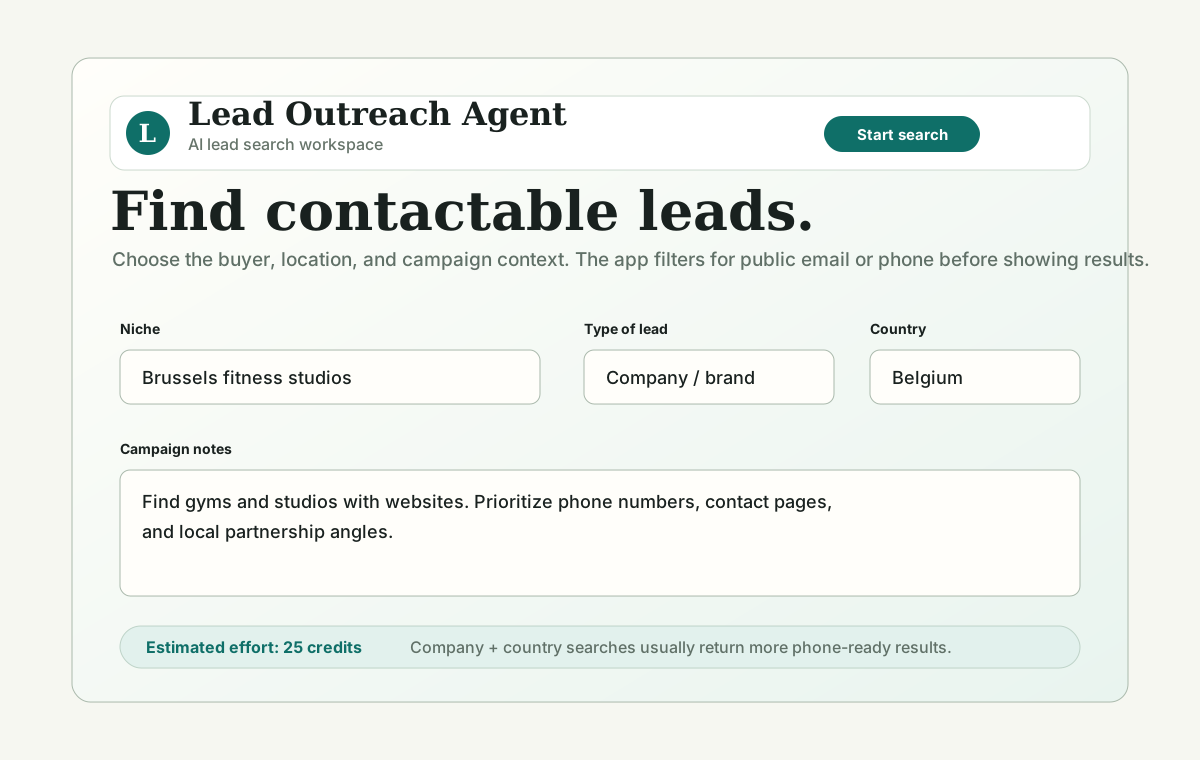
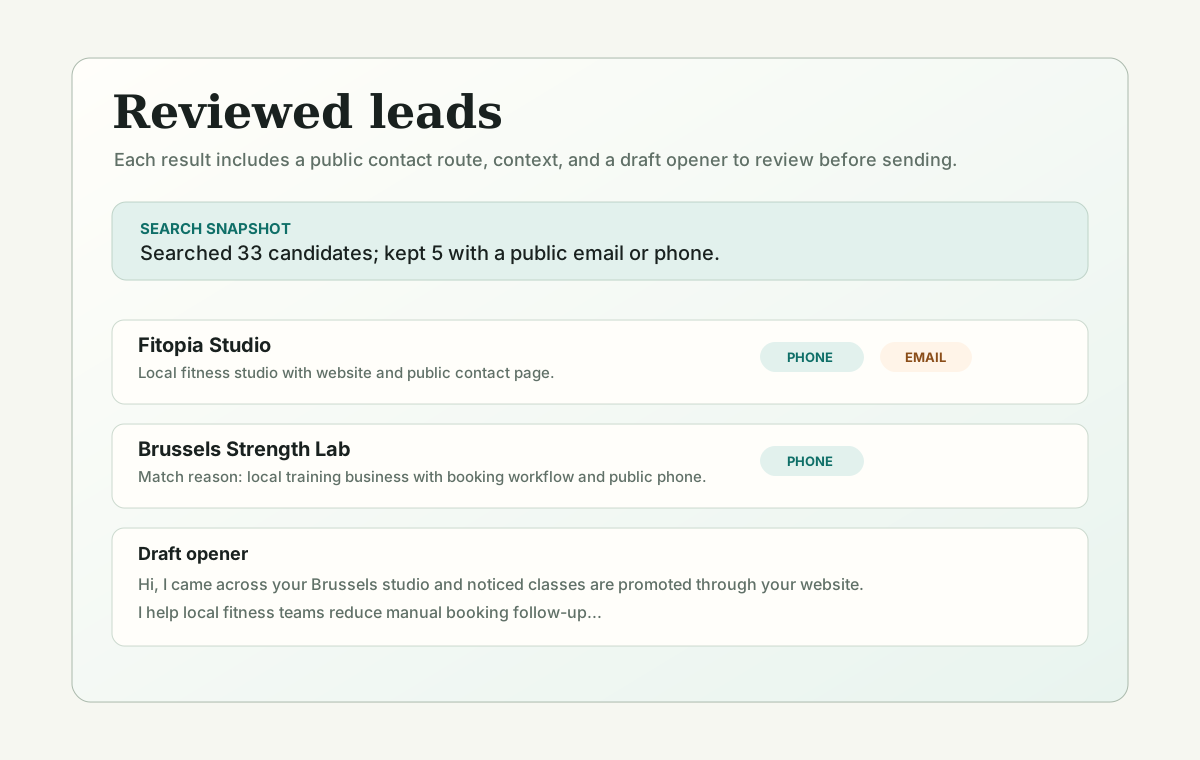
The model finds fit and drafts a specific opener - it does not spray identical volume.
Every contact route is public and linked, so AI output stays checkable.
AI drafts; a person verifies, edits, and decides whether to reach out.
Use these findings as context, not promised results. Each source includes its sample or method and the limitation that matters when applying it.
Teams that use AI to make each message more relevant report meaningfully higher reply rates - signal-personalized outreach around 15-25% versus a 3-5% cold average - while teams that use AI only to send more messages underperform the human baseline.
Aggregated analyses put B2B contact-data decay at roughly 22.5-30% per year - about 2.1% per month - and as high as 70% at fast-moving tech companies, with job-title changes the single biggest driver.
Sales reps report spending almost one workday per week prospecting; 92% of sales professionals using AI agents say AI benefits prospecting.
B2B buyers use an average of ten channels during the purchasing journey, and market leaders are four times more likely to deploy true one-to-one personalization.
Results need a usable public email or phone number and enough source context for review.
Each result includes context to help you check why the lead fits before outreach.
Drafts remain editable and should be reviewed for accuracy, relevance, and compliance before sending.
Seven tools worth knowing, ordered for a team that wants AI leverage without AI recklessness. Each is capable; the ranking reflects fit for grounded, relevant outreach with a human on the send decision.
| # | Tool | Best for | Watch out for |
|---|---|---|---|
| 1 | Lead Outreach Agent | AI for fit and first drafts, with a human on send | Focused on discovery and drafting, not autonomous sending |
| 2 | Clay | AI enrichment and GPT columns inside a workflow | Powerful, but you build and maintain the pipeline |
| 3 | Apollo AI | An AI assistant layered over a large database | Output is only as fresh as the underlying database |
| 4 | 11x / AI SDRs | Autonomous AI SDRs that research and send | Auto-send carries deliverability and compliance risk |
| 5 | ZoomInfo Copilot | AI over enterprise data and buyer intent | Enterprise pricing and contracts |
| 6 | Instantly / Smartlead AI | AI-assisted cold email at scale | A sending tool, not discovery; volume-first by design |
| 7 | Lavender | AI email coaching to lift reply rates | Improves messages but does not find the leads |
The same technology, aimed at opposite goals. Only one of them improves reply rates.
| Dimension | AI-for-volume | Lead Outreach Agent |
|---|---|---|
| Goal | Send more, faster | Make each message more relevant |
| Contact data | Often AI-guessed | Public, linked to source |
| Message | Near-identical at scale | Drafted from a real match detail |
| Human role | Approve the blast | Verify, edit, decide to send |
| Typical outcome | Below human baseline | Higher reply rate, lower bounce |
"AI prospecting" spans two very different goals: using AI to send more, or using it to make each message more relevant. The ranking below favors the second, because the data is clear that relevance wins and volume-only AI underperforms a careful human. Tools that ground AI in real, public data and keep a human on the send decision rank highest; autonomous auto-senders rank lower on reply quality and compliance risk. Full disclosure - Lead Outreach Agent is our tool, placed first for this audience; every other tool gets a straight take and a real catch.
AI is good at reading a plain-language target and turning it into a search, at judging whether a public business matches that target, and at drafting a specific opener from a real detail. It is bad at manufacturing consent or inventing contact data. Lead Outreach Agent leans on AI for the first set and refuses the second - it only surfaces contact routes that are actually public.
The single most repeated 2026 finding is that using AI to send more, not better, underperforms a human baseline, while relevance-focused AI outreach replies at 15-25% versus 3-5% cold. AI that drafts ten thousand near-identical emails is a deliverability risk, not an advantage. The value is in relevance per message, which is why every lead here carries a match reason the draft can use.
Lead Outreach Agent drafts the first message and then hands it to you. That is deliberate: a human should confirm the public detail is real, adjust the tone, add truthful sender information, and decide whether contact is appropriate. AI accelerates the blank-page problem; it does not get to press send on your behalf or on your reputation.
Because the model only works from public sources and keeps the source link, its output is checkable. That matters for AI specifically: an ungrounded model will happily produce a plausible-looking email address, and a plausible address that bounces costs you a send and a bit of sender reputation. Grounding the tool in public evidence is what keeps AI convenience from becoming AI guesswork.
Founders testing an ICP, agencies building targeted client lists, and lean sales teams that want AI leverage without AI recklessness. If your goal is to carpet-bomb a database, this is the wrong tool by design. If your goal is more relevant conversations with reachable people, AI aimed at relevance is exactly the leverage you want.
AI marketing is loud, so evaluate the tool on plain questions. Where does the contact data come from, and can you open the source for any lead? Does the AI ever fabricate an address to fill a row, or does it only surface public routes? Who presses send - the tool, or a person who verified the detail? And is it optimizing for more messages or for more relevant ones? Answers that favor sourced data, human review, and relevance point to a tool that will help; answers that favor automated volume point to a deliverability and compliance problem wearing an AI label.
They are prospecting tools that use AI to find leads, judge fit, or write outreach. The results depend entirely on where the AI is aimed - at sending more messages, or at making each message more relevant to a reachable person.
Only when it is used for relevance. Research consistently shows AI used to increase volume underperforms a careful human, while AI used to personalize outreach can lift reply rates well above cold averages.
It writes the first draft, but it does not send. A person verifies the public detail, edits the message, adds honest sender information, and decides whether contact is appropriate. Sending happens in your own tools.
It only surfaces contact routes that appear in public sources and links to where each came from. It will not fabricate an address to fill a row, which is a common failure mode for ungrounded AI tools.
Yes, and deliberately. Auto-sending AI optimizes for volume and carries deliverability and compliance risk. This keeps a human in the loop for verification and the send decision.
Public availability is not consent, and AI does not change that. You are responsible for a lawful basis, honest identification, and a working opt-out under your recipients' rules.
Start with one narrow search, review the contactability and match reasons, then use the related tools or benchmark pages to decide whether the niche is worth scaling.